Understanding Full vs. Partial Dentures: What’s the Difference?
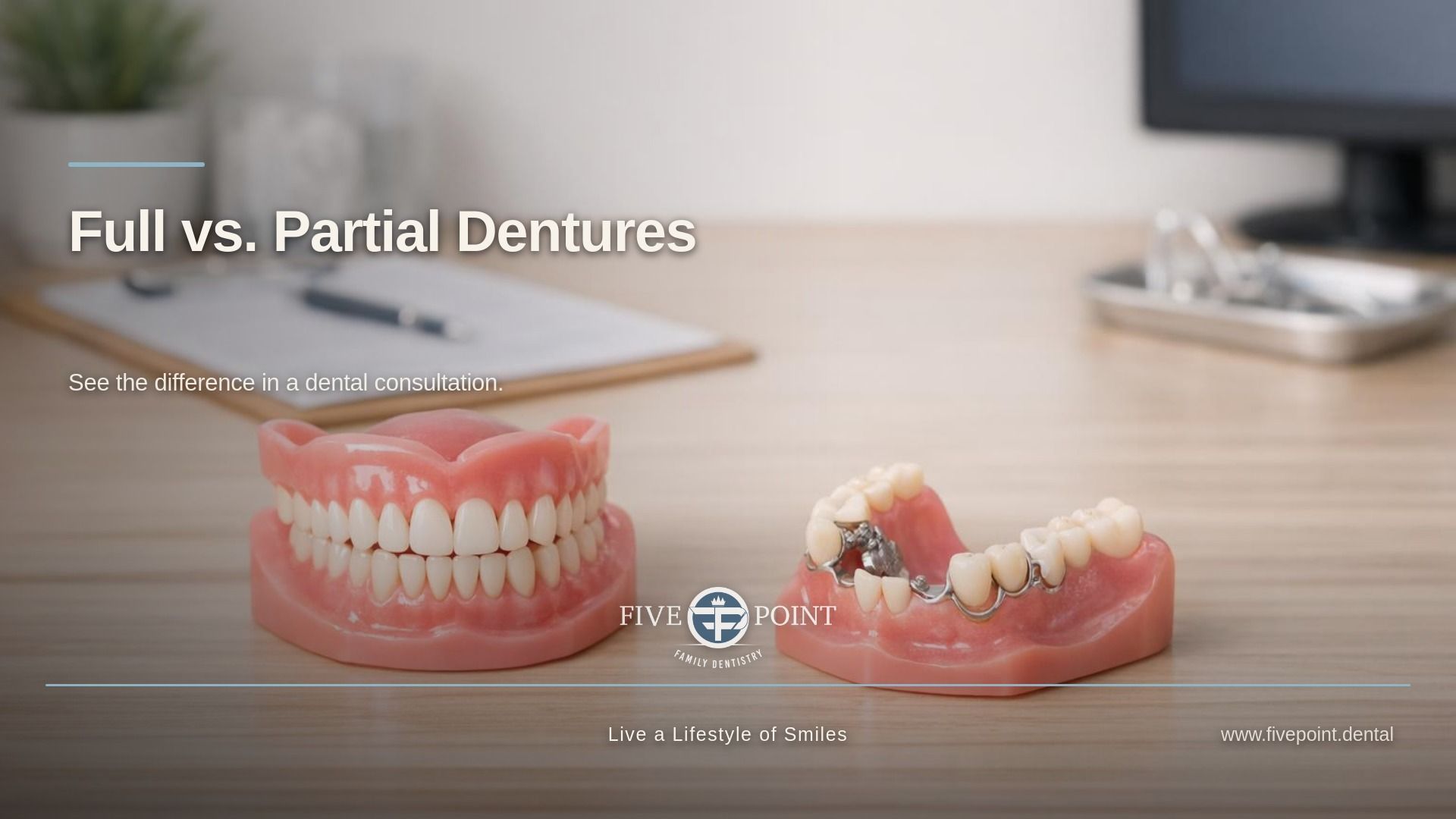
Understanding the difference between full and partial dentures can help you prepare for a conversation about missing teeth. A full denture replaces all teeth in an upper or lower arch. A partial denture replaces missing teeth when some natural teeth remain. These descriptions explain the general distinction; they do not establish which treatment is appropriate for an individual person.
An exam is the point where your own needs, remaining teeth, and treatment options can be evaluated together. The number of missing teeth is one part of that discussion, rather than an answer on its own. You can explain what you want to understand and ask how your remaining teeth relate to the options being considered for your situation.
Before your appointment, consider writing down the questions you would like to discuss. For example, you might ask what distinguishes a full denture from a partial denture in your case, what alternatives should be considered, and what information is needed before making a decision. You can also ask about expectations and ongoing care without assuming that a particular result is assured.
For people in Olathe and Johnson County, learning these terms can be a starting point for an individual discussion with Five Point Family Dentistry. Dentures are not the only possible tooth-replacement option, and general educational information cannot determine candidacy. An exam and conversation about your goals provide an opportunity to review options and questions. Fit, comfort, appearance, eating ability, timing, and outcomes cannot be promised by this overview.
To schedule with Five Point Family Dentistry, call 913-390-3555 or visit https://www.fivepoint.dental
How do a full denture and a partial denture address different tooth-replacement needs?
A full denture replaces all the teeth in an upper or lower arch when no natural teeth remain, while a partial denture fills spaces where some natural teeth are still present. The choice between them depends on an individual exam, review of remaining teeth, and a discussion of your treatment options.